The Canvas Forest: How a 17th-Century Wind Revolution Built a Global Superpower
The Silicon Valley of the 17th Century
To a modern visitor, the traditional Dutch windmill looks like a picturesque relic—a quiet monument standing tall over calm shores. But to the merchants, engineers, and sailors of the 17th century, these machines were roaring, high-performance engines that fueled a global superpower.
During the Dutch Golden Age, the Netherlands wasn't just grinding grain. It built an advanced industrial revolution. Harnessing the unrelenting North Sea winds, the Dutch created a concentrated industrial cluster—effectively the Silicon Valley of the early modern world. Rather than a primitive, pre-industrial society, the 17th-century Netherlands boasted a surprisingly sophisticated economy powered by a complex network of high-tech machinery.

A Land Powered by 9,000 Engines
The sheer density of mechanical energy in the 17th-century Netherlands was a true historical anomaly—something that wouldn't be seen again until the smokestacks of Britain's Industrial Revolution. At their peak, nearly 9,000 windmills were operating across the Dutch Republic. Flying over the Zaan region north of Amsterdam back then would have revealed a literal forest of oak and canvas, capturing mechanical energy on a scale that surpassed entire empires. To put that in perspective, the Dutch operated as many mills as all of England, despite having less than half the population.
This incredible concentration of kinetic power gave the country an unbeatable competitive edge. While rival nations relied on slow, expensive manual labor or location-dependent water wheels, the Dutch deployed specialized mills to dominate global manufacturing in everything from shipbuilding to snuff production. Building these behemoths was high-level engineering at its finest.
"The post-mill was a daring construction. Harmonizing its various parts was an authentic test of the genius of the carpenters and mill-wrights." — Edward Kealy
The Invention That Built an Empire: The Sawmill
Raw power alone wasn't enough; the Dutch needed a game-changing application. They found it in the wind-powered sawmill. In the 16th century, timber was the lifeblood of the global economy—the essential material for the merchant fleets that ruled the seas. The primary bottleneck wasn't getting the wood (vast rafts of timber were floated down the Rhine), but processing it. Manual pit-sawing was excruciatingly slow, labor-intensive, and limited logs to lengths of no more than four meters.
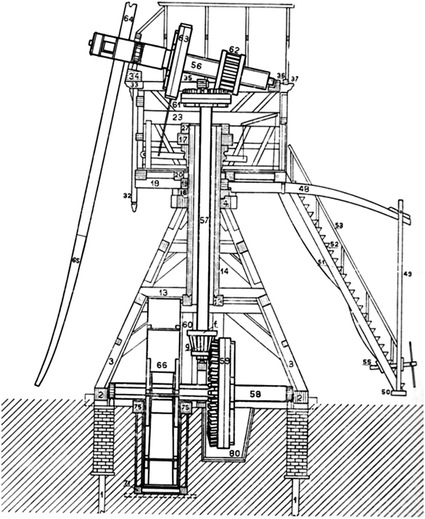
Everything changed in the 1590s when Cornelis Corneliszoon van Uitgeest patented the wind-powered sawmill. His design elegantly converted rotary motion into linear sawing force: a horizontal crankshaft drove the saw frame up and down, while an ingenious iron rack mechanism steadily pulled timber through the blades. By using an iron rack instead of unreliable rope drives, Corneliszoon solved the mechanical bottleneck once and for all.
This single breakthrough allowed the Dutch to construct the world's largest merchant fleet at a speed and scale their international rivals simply couldn't match.

The Rotating Roof: A Engineering Masterstroke
Dutch mill technology advanced through relentless experimentation and refinement. The earliest European design was the Post Mill (or "ground winder"), where the entire wooden building containing all the heavy machinery rested on a single massive vertical post. To catch the changing wind, the miller had to physically rotate the entire building by hand.
Then came a brilliant engineering insight in the 14th century: why rotate the whole building when you can just rotate the roof? This realization split mill evolution into two main branches:
Ground Winders (The Post Mill Line): These evolved into the hollow post mill (<i>wipmolen</i>), bridging the gap between grain grinding and large-scale water management.
Cap Winders (Tower and Smock Mills): By designing circular, hexagonal, or octagonal buildings, engineers could keep the main structure fixed and rotate only the top cap. This allowed mills to become massive, stable, multi-story industrial complexes.
To maximize aerodynamic efficiency, millers crafted asymmetric blades with wind boards and a subtle sail twist—curving from 25 degrees at the base to 5 degrees at the tip. Borrowed from maritime sailmaking, this aerodynamic design allowed Dutch mills to harvest wind energy with unprecedented precision.
Function Meets Form: The Story Behind the "Paltrok"
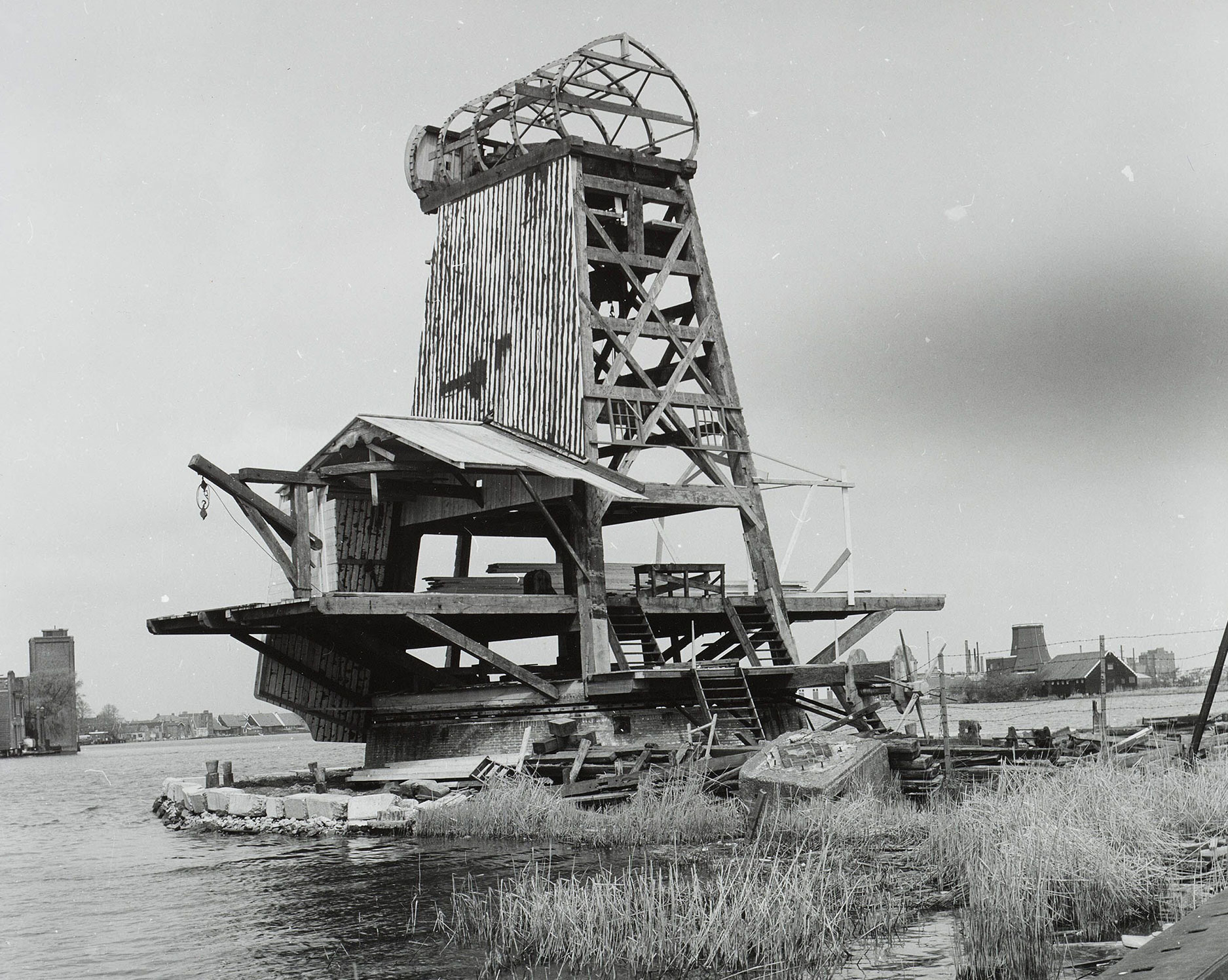
One of the most specialized offshoots of Corneliszoon's patent was the Paltrok mill. Purpose-built for timber sawing, it was a ground winder resting on a short central post and a ring of brickwork rollers, allowing the entire body to turn smoothly into the wind.
Inside, the Paltrok was a masterpiece of mechanical balance. Its crankshaft featured three offset throws set at 120-degree angles: the outer two drives powered the saw frames, while the middle throw operated an "empty pump frame" purely to counterweight the motion and keep the mill running smoothly. Outside, wide wooden side wings extended from the body to shelter workers and long timber logs from harsh weather. Because the mill always faced directly into the wind, these protective walls created an ideal workspace. With its flared wooden silhouette, the mill strikingly resembled a popular 17th-century jacket or skirt called a <i>paltrok</i> (from the Dutch <i>rok</i>, meaning skirt).
Engineering the Map: Draining the Polders
The Dutch didn't just live on the land—they engineered it into existence. Between 1564 and 1632, the Republic drained eight large lakes, reclaiming over 27,000 hectares of farmland. This massive land reclamation relied on a sophisticated hierarchy of hydraulic machinery, ranging from small hollow post mills (<i>wipmolen</i>) to giant octagonal smock mills.
The true technological turning point came in 1634, when engineer Symon Hulsebosch revolutionized water pumping. He realized that an Archimedean screw didn't need to be encased in a heavy, fragile rotating cylinder; placing it in an open semi-circular gutter made it significantly lighter and dramatically boosted its pumping capacity compared to traditional paddle wheels. This innovation—the open-gutter screw—became a cornerstone of Dutch hydraulic supremacy.
Theory vs. Practice: Why Simon Stevin's Redesign Failed
The evolution of the windmill highlights a fascinating clash between formal academic theory and practical craftsmanship. Renowned mathematician Simon Stevin (1548–1620) attempted to bring mathematical precision to mill design, formulating a "Fundamental Relation" to calculate the exact force balance between wind and water.
Stevin proposed a radical overhaul featuring a massive paddle wheel and gear ratios designed to slow wheel rotation to overcome water resistance. While standard mills accelerated the gearing before stepping it down, Stevin's model relied on a steep gear reduction right from the start. The result was an engineering failure: the immense torque placed far more stress on the gear teeth than traditional oak gears and beeswax lubricant could withstand.
His calculations were flawless on paper, but they ignored the hard-earned practical wisdom of master millwrights, who understood the physical limits of timber and grease under load.
The Wind Legacy
By the height of the 17th century, the Netherlands had sparked a true industrial revolution powered entirely by air. Alongside grain mills, wind-driven machinery hulled rice, pressed oil, manufactured paper, ground mustard, bored cannon barrels, processed leather bark, and shredded tobacco leaf.
As the 18th century came to a close, the rhythmic creak of sails gradually gave way to the hiss of steam power—much like the energy transitions we face today. Yet the Dutch windmill remains far more than a postcard icon: it stands as a monument to human ingenuity and a reminder of an era when a global empire was built on wind power alone. As we transition back toward renewable energy, one can't help but wonder: what story will future generations tell about our own energy revolution three centuries from now?